Dungeon

In the Middle Ages, the perpetrators were mostly punished by fines, mutilation or execution, while those who were imprisoned were expected to be ransomed. The prisoners were kept in relatively good living conditions because a dead prisoner wasn't of much worth to their captor. Most of the stories about torture, imprisonment and murders that took place in the castle dungeons belong to the post-medieval period of the seventeenth and eighteenth centuries.
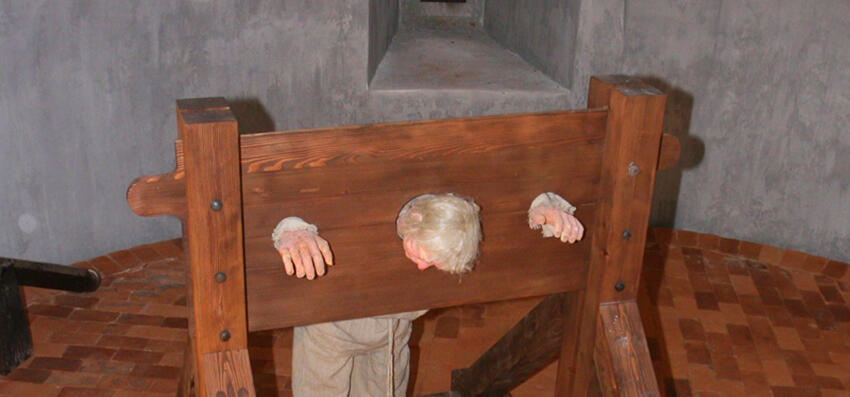
Here one can see a reconstruction of a torture scene using the stocks. The jailor would put the prisoner's neck and wrists in the openings intended for this purpose and in that way would limit the prisoner's ability to move. This would be done in order to execute a sentence or to force the prisoner to make a confession.
The evidences that prove the existance of a dungeon in the Trakošćan Castle are an inscription and a mural preserved on the vault of the enclosure wall of the pilgrimage church of St. Mary of Jerusalem on the Trški Vrh hill near Krapina. The extant text speaks of a certain Nikola Capek from the nearby village of Bednja who expressed his gratitude for being proved innocent and released from the dungeons of Trakošćan Castle by the intercession of the Blessed Virgin Mary.