Short genealogy
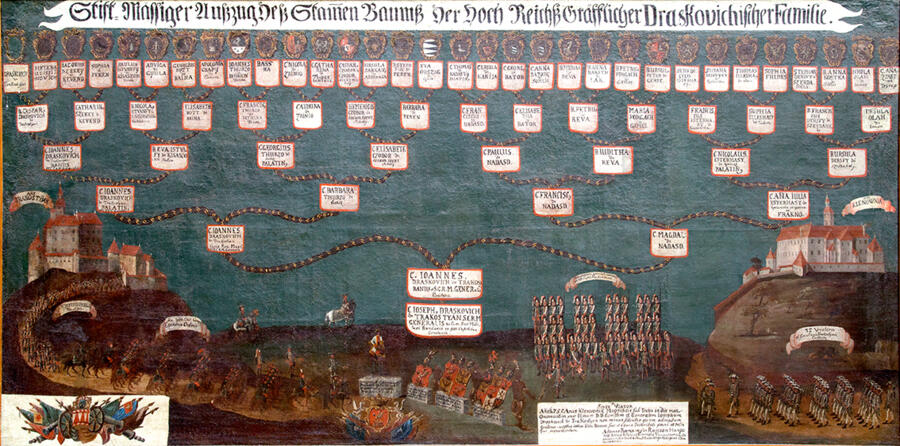
In the winter of 1755, Count Josip Kazimir Drašković hosted in Klenovnik a Hungarian noble by the name of Adam Ransony of Rajesan, who was a royal chamber counselor at the Hungarian court and the commissioner for the Kingdom of Croatia. To return the favor, the guest offered a painted canvas as a Christmas Eve present for his host. The canvas was made to highlight the Count's centuries old noble origins and his affiliation to the circle of comital families that were directly acknowledged by the Holy Roman Empire. The guest wanted to emphasize Josip Kazimir Draškvić's high military position as an imperial and royal general and a commander of a military unit.
The painting is called Short Genealogy because it only features a small part of the Drašković family, the direct ancestors of General Josip Kazimir Drašković.
Description of the painting
The canvas is divided into two different parts in terms of language and contents: the upper one is in German and displays the Count's genealogy, and the lower one is in Latin, which was the official language back then, and describes his military position and power.
On the right side is Klenovnik, the largest castle in Croatia, and on the left side is Trakošćan, at the time a military fortress of the Drašković family. The troops of foot-soldiers, grenadiers, dragoons, hussars, riflemen and guards are seen leaving through the gates of both towns.
The numbers regarding the strength of the troops according to respective branches is writen in the center of the lower part of the painting. Drašković's army allegedly numbered 932 soldiers. There were 500 foot-soldiers, 100 grenadiers, 300 horsemen and 32 riflemen or town guards.
There are three coats of arms of the Drašković family at the bottom of the painting. The oldest and the most simple single-field coat of arms dates back to the time when the family held the title of baron. In 1631, they acquired the title of count and with it the right to the four-field coat of arms, and in time even the nine-field one, a rare occurance for Croatian noble families.