Grassland communities






Did you know....
Grass is a herbaceous plant which copes well with drought. Although they look gentle and fragile, they are very resistant to wind influence. They quickly recover their leaves and stems after the mowing and grazing, and they can recover three times during the year. They are important as agricultural plants, because they make up the basis of hay – dry vegetable food for animals.
Plantain (Plantago) is a widely spread and easily recognizable meadow plant. It was used in China 3000 years before Christ to heal many illnesses. This old folk medicine is mostly used as a cure for coughing and other respiratory diseases.
Unusual names for orchids are related to the looks of honey lip (labellum), one of the three petals on orchid flower. Honey lip of the Bee Orchid flower looks so much like a bee, the males tries to fertilize it.
Pollination of some orchid species is completely dependent on moths. Namely, some species of the family butterfly orchids (Platanthera) release intense scents at night which attract the moths which then pollinate them.
GRASSLAND COMMUNITIES
Grassland are plant communities that mostly consist of grass and other herbaceous plants, and do not usually include woody shrubs or trees. Grassland may occur naturally or artificially. Natural grassland occur on surfaces where there are no conditions for growing trees or shrubs, as well as on the mountains above the limit of forest growth.
Most grasslands in Europe occurred under the human influence, reflected in forest clearance, regular mowing, setting fires or cattle grazing. These areas are called 'semi-natural grassland'. Mown grassland are called hay meadows, while pastures are grasslands grazed by cattle.
Traditionally, extensive grassland management (mowing or extensive grazing, no artificial fertilizers) creates mosaics of grassland habitats that are rich with diverse plant species. They contain numerous medicinal and edible herbs, but also some rare species like irises or orchids. Such mosaic of grassland habitats are also supported by various invertebrates, birds and mammals, which provide food (leaves, nectar, seeds, prey), shelter and places for nests. If the human influence terminates, regular mowing or grazing in particular, grasslands become overgrown and they slowly turn into forest habitats. Moreover, the entire diversity of the plant and animal world disappears with them.
In the Trakošćan area there are two dominant types of grassland. In the valleys by the River Bednja and streams (Čemernica, Kal, torrent water flows) there are wet grassland, and in the mountain area (on the hills around Trakošćan) there are dry grassland. Explore and discover something about them!
Meadows of Bald Brome and Crested Dogstail
(As. Bromo-Cynosuretum cristati)
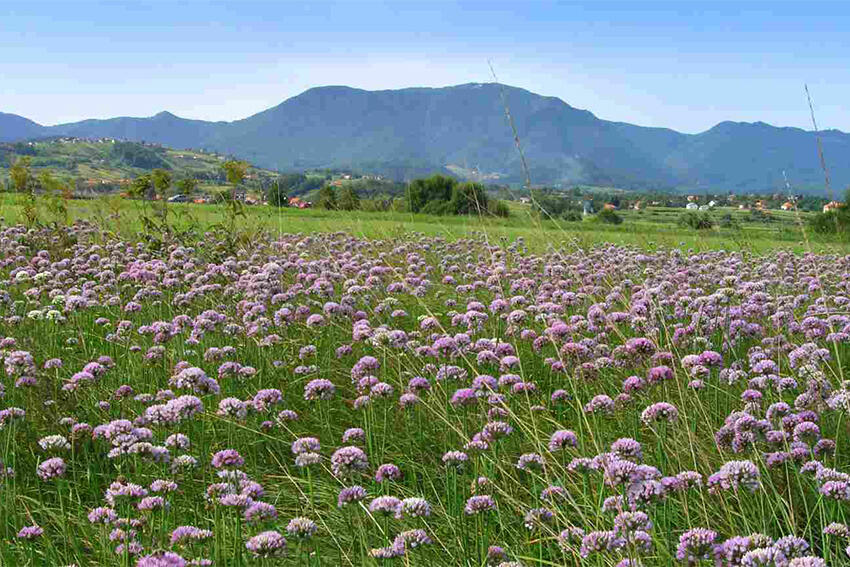
This meadow community spreads out along the River Bednja, on flat surfaces that are sometimes flooded during the year, mostly when there are strong rainfalls and floods due to the snow melting. The water remains for a short time, a day or two or for several hours. There are three aspects developed on this meadow – white with the Cuckoo Flower (Cardamine pratensis), yellow with the Common Buttercup (Ranunculus acris) and pink with the Ragged Robin (Lychnis flos-cuculi). Here and there we can find a rare fern Southern adderstongue (Ophioglossum vulgatum), the Mouse Garlic (Allium angulosum), the Siberian Iris (Iris sibirica), and among orchids there is the species of orchid (Orchis laxiflora ssp. elegans) and the Western-marsh orchid (Dactylorhiza majalis).
Dry continental grassland
(Festuco-Brometalia)
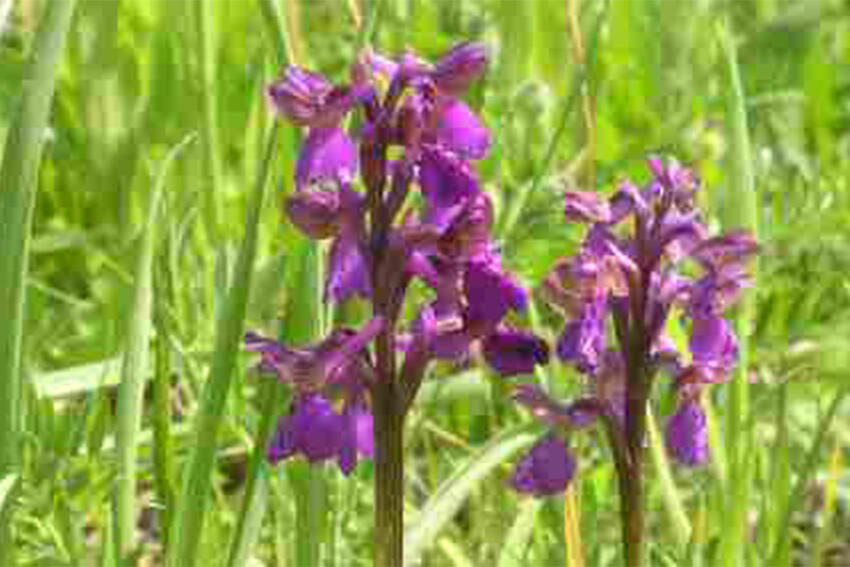
The hills surrounding Trakošćan contain dry mountain grassland from the Festuco-Brometea class, of the Brometalia erecti order, all of which occurred because of the forest clearance. Here, a dominant grass is the Upright Brome (Bromus erectus). These grasslands are significant for their floristic diversity, and they are particularly important as habitats rich with orchids. A rare orchid called the Adriatic Lizard Orchid (Himantoglossum adriaticum) grows on them. It has been included as a species in the Natura 2000 ecological network. Other orchids on this grassland include the Green-winged Orchid and the Three-toothed Orchid (Orchis morio and O. tridentata), the Pyramidal Orchid (Anacamptis pyramidalis), the Late Spider Orchid and the Bee Orchid (Ophrys fuciflora and O. apifera).