Biedermeier room
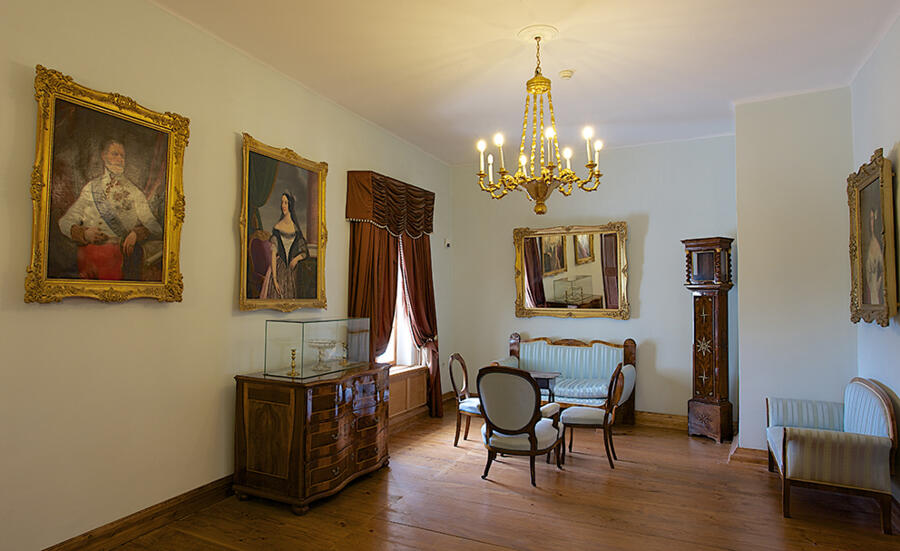
The basic characteristics of the Biedermeier style, chronologically confined between the Vienna Congress in 1815 on the one end, and the revolutionary year 1848 on the other end, are the emphasis on private life and the awareness of the tradition. The Biedermeier style frequently borrows from the past and withdraws to the intimacy, which is even more evident in musical and literary works. It was focused primarily to interior and everyday life objects. Even though it appeared with the increasingly affluent bourgeoise, its influence was also accepted by the nobility.
The furniture of that period is comfortable and by functionality very similar to today's modern furniture, polished to the shine as is seen in the Takošćan example. Two three-seat couches are upholstered with striped fabrics of lighter colors, which was a pattern often used at that time. There are also two commodes, a self standing clock case, a mirror in a gilded frame. The room is illuminated by two wall candelabras and a chandelier. Window curtains are of the more recent make but completely adapted to the spirit of the presented period.