Neo-Renaissance room
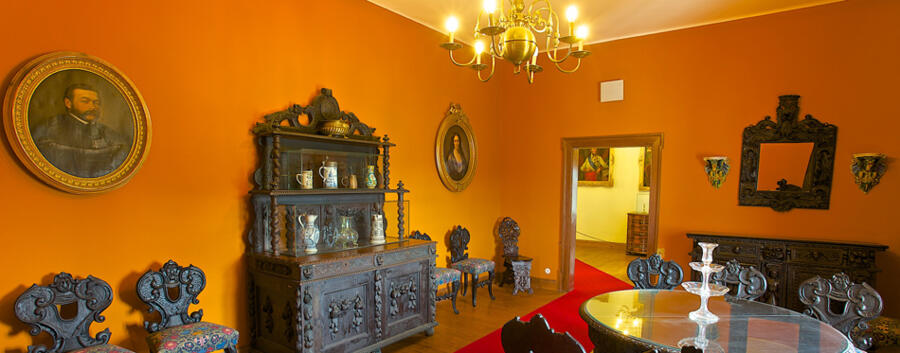
The Neo-Renaissance is a form of historicism that materialized in the second half of the nineteenth century.
Most of the Trakošćan Castle interiors on the ground floor and the first floor were furnished with a neo-style inventory following a major restoration in the nineteenth century. Furniture pieces featured in this room are dyed in black: a buffet, a round stretching table with chairs, three chairs with carved, stripped backs in the form of a mascaron, and two mirrors. A part of the furniture was brought as a dowry by the painter Julijana Erdödy, to which the letter E located in the upper part of the buffet testifies. On the walls, there are also two dragon-shaped consoles and one brass support for oil lamp. Particularly worthy of mention is an original commode from the Renaissance period, the oldest piece of furniture in the museum. The deep-carved grotesque heads also serve as narrow drawers of the commode. The commode nicely fits into the rest of the room's furniture, even though it is three centuries older. The furniture in the adjacent Biedermeier room vastly differs in its form from the Neo-Renaissance style, which makes it seemingly impossible that they are separated by only fifty years.
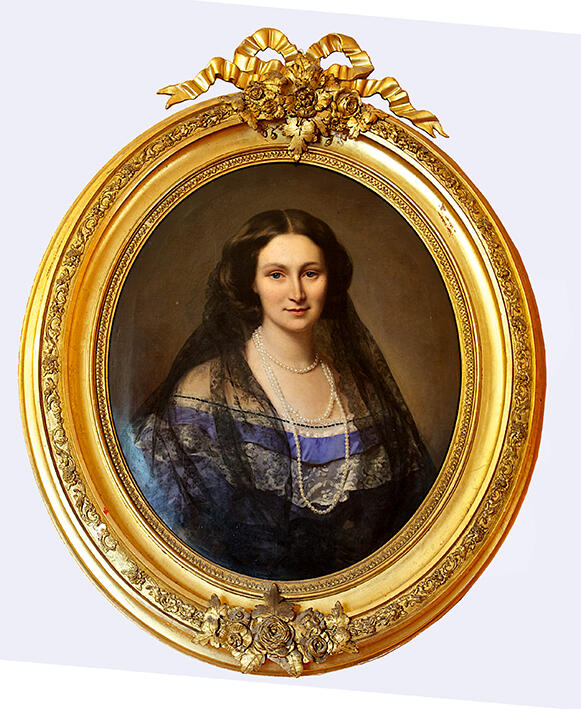
Portrait of Klotilda Drašković
The portrait of Klotilda Drašković, née Kulmer, is one of the most beautiful portraits in the castle. A member of high nobility, she quickly became a renowned donor to cultural institutions and hospitals. With her husband Franjo III Drašković, she had a daughter named Fernandina who married Count Markus de Bombelles (1830 – 1906). It is to their merit that one of the most beautiful parks in Croatia was established around the Opeka Castle. As a wedding gift, they received the Zelendvor estate, where there is still a well-known hunting ground, which was also visited for hunting by members of the imperial family at the turn of the century.