Two-handed swords
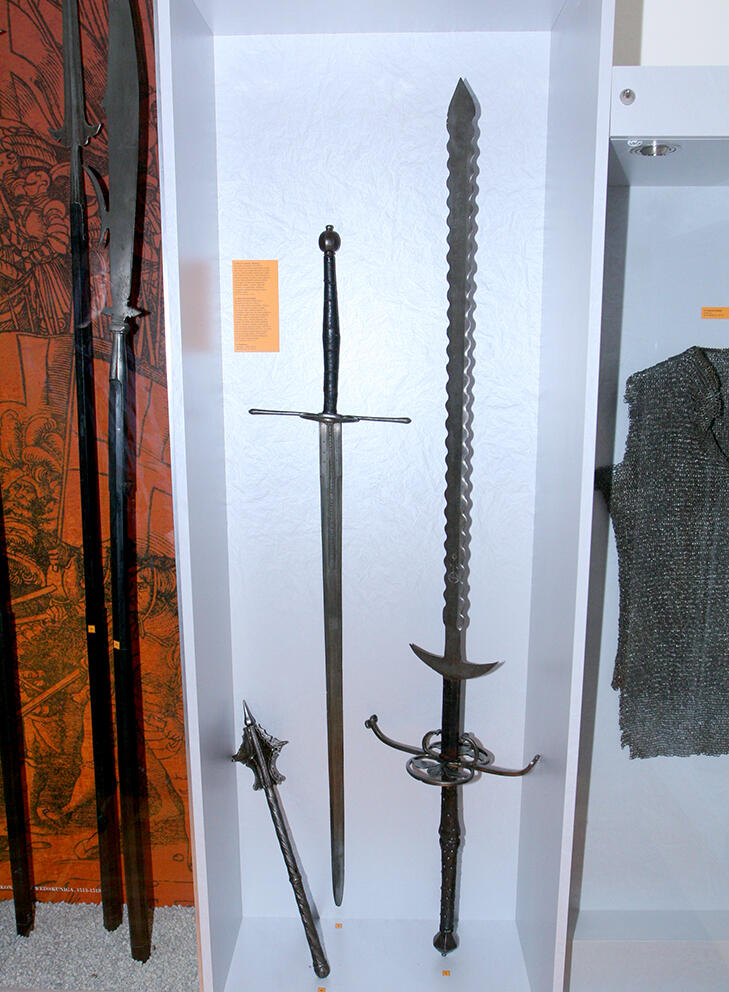
Two-handed swords were used in battles since the thirteenth century. They reached their full glory and application in the fifteenth and sixteenth centuries, and especially in the second half of the sixteenth century, when there was a new change in the appearance and purpose of the weapon.
In the fifteenth and sixteenth centuries two-handed swords were used as weapons by mercenary foot-soldiers (for example, Landsknechts). Their task was to drive, in the front battle lines, a wedge into the ranks of the enemy equipped with long polearms. In so doing, they would wield their swords cutting the poles made of sooftwood and thereby weakening the defense. A great skill was needed in the fighting and it was highly appreciated if a mercenary could prove that he had mastered the technique, as well as where and from which master he had learned it.
However, combat effectiveness came to the fore only if they were in the midst of hostile ranks, whereas their fellow combatants had to be at a distance from them of a double sword length. Because of this, they also received a double pay in comparison to other soldiers.
Sword - a symbol of honor
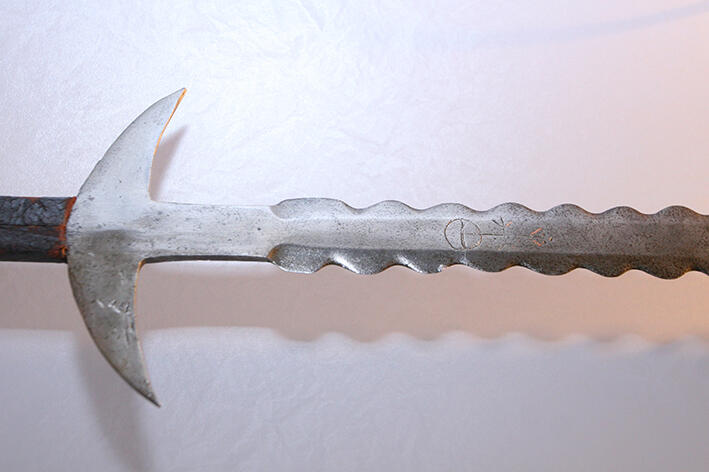
Two-handed swords were of poor use for fighting, and from the second half of the sixteenth century their were already associated with arms carried by honor escorts and guards, and in particular the color guards of the field marshals and army commanders. Parts of the swords began to be adorned, and the techniques and motifs of decoration were accomplished in the spirit of the late Renaissance, an became so imaginative and diverse that these weapons could no longer be regarded as a fighting equipment, but more as a mark of honor, authority and a ceremonial symbol. This is particularly valid for the bent curvatures of the crossguard, the ring for parrying strikes, and lateral arches, as well as for the undulating edges of the blade of the so-called "flame-bladed swords" (Flamberg).
Two-handed swords were, as their name says, swords with long grips and blades that were wielded with both hands. The usual length of the sword was between 140 and 180 centimeters, and it weighed between 3 and 5.5 kilograms. The blade of the sword could be straight or wavy (the so-called flame blade).